Malta is often called “The Land of Honey.” The Greek name melite, meaning honey or sweet, may reference the native honey bees, while another theory traces the name to the Phoenician word maleth, meaning haven or port. The precise origin remains uncertain.
Located in the central Mediterranean, Malta is an archipelago of eighteen islands, three of which are inhabited. The largest island, Malta, hosts the capital Valletta. Gozo is quieter and more rural, and Comino is a small nature reserve. The islands sit about 50 miles south of Sicily, 176 miles east of Tunisia, and 207 miles north of Libya, covering a combined area of just 121 square miles. With roughly 450,000 residents, Malta ranks among the most densely populated countries in the world.
Formed when rising seas broke an ancient land bridge between Sicily and North Africa after the last Ice Age, the Maltese islands rest on the Malta plateau. Their human history stretches back to at least 5200 BC and includes some of the oldest freestanding structures on Earth, dating to 3500 BC—sites now protected as UNESCO World Heritage. Because of its strategic position, Malta has been a prized naval base and target for conquest across millennia. The Phoenicians, Carthaginians, Romans, Moors, Normans, Sicilians, Spanish, Knights of St. John, French and British have all ruled here. Malta gained independence from the United Kingdom in 1964, is a member of the Commonwealth, the UN and the EU, and joined the Eurozone in 2008.
In recognition of its courage during World War II, King George VI awarded Malta the George Cross in 1942; the emblem remains displayed on the national flag. Malta is also one of the oldest continuous Christian communities. According to the Acts of the Apostles, Paul the Apostle was shipwrecked here in 60 AD and helped establish Christianity on the islands. Catholicism plays a prominent role in daily life and public holidays. From June through September, towns and villages celebrate weeklong festas honoring local saints. These festivals feature ornate decorations, statues, painted tapestries and culminate in fireworks displays. Christmas is marked by customs such as serving qugħaq ta’ l-għasel, pastry rings filled with local honey.
With more than 360 churches, the parish church anchors every Maltese town and village. The Mosta Dome, one of the largest churches in Malta, has the third-largest unsupported dome in Europe. During World War II, a 500 kg bomb penetrated the dome while about 300 people waited for Mass but remarkably did not detonate; a replica is displayed inside the church.
Two official languages are spoken: Maltese and English. Maltese is a Semitic language enriched by Sicilian, Italian, French and English influences and uses a 30-letter Latin-based alphabet. The population is highly multilingual: everyone speaks Maltese, 88% speak English, 66% speak Italian and 17% speak French. The University of Malta, founded in 1592, is the oldest university in the Commonwealth outside Britain.
In 1530, Charles V granted Malta to the Knights of St. John, known as the Knights of Malta. They famously defended the islands during the Great Siege of 1565. The eight-pointed cross associated with the order became the Maltese cross, a national symbol. Grand Master Jean Parisot de Valette led the defense and founded Valletta.
Malta’s modern economy is diverse and growing. Natural limestone, a strategic location and a productive workforce are important assets. The economy relies on foreign trade, trans-shipment, electronics and textile manufacturing, tourism, film production, gaming, aircraft and ship registration and financial services. Malta has explored offshore petroleum prospects and is classified as an advanced economy by the IMF. Challenges include limited arable land, producing only about 20% of its food, scarce freshwater resources and dependence on desalination during droughts.
Maltese cuisine reflects its layered history, blending Sicilian, English, Spanish, French, Maghrebin and broader Mediterranean influences into distinct local dishes. The national dish, stuffat tal-fenek, is rabbit stewed in wine and spices. The flavorful broth is often served with pasta as a first course. Gozo’s cheeselet, gbejna, appears in many recipes, and crusty bread known as hobz biz-zejt is a staple. Bigilla is a savory mashed broad-bean dip with anchovies, garlic and chili. Kunserva, a sweet tomato paste, is used as a condiment—often spread on bread with capers, tuna, anchovies, olives and olive oil. Pastizzi, golden filled pastries sold on many corners, are a beloved snack.
To illustrate a Maltese meal, here is a suggested menu served in the traditional continental style:
The Menu
Starter
Zebbug Mimli (Stuffed Olives)
Served with
Pastizzi (Curried Pea and Ricotta Stuffed Pastries)
Salad
Maltese Insalata (Garden Salad)
Main Course
Bragioli (Beef Olives)
Served with
Froga-Tat-Tarja (Cheesy Pasta Omelette)
Dessert
Maltese Gelat (Ice Cream)
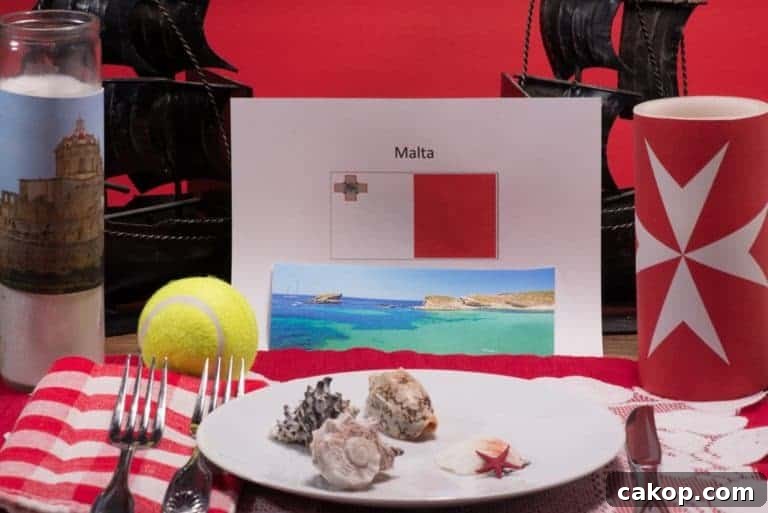
For our meal we used the national colors of red and white in the table décor and added small touches referencing Malta’s maritime heritage and historic fortified cities such as Mdina. Eating continental-style, we began with stuffed olives—large olives filled with anchovy, tuna and garlic—and freshly made pastizzi: flaky pastries filled with ricotta or curried peas. Both were enjoyed with cheese, salami and wine.
The salad was a simple insalata made with romaine, cucumber, sweet pepper, red onion, carrots and tomatoes, finished with basil and thyme, a light drizzle of olive oil, a splash of white vinegar, minced garlic and black pepper.
For the main course we served bragioli: thin beef slices rolled around a filling of breadcrumbs, bacon, garlic, parsley and hard-boiled egg, then braised slowly in red wine with sautéed onions, carrots and bay leaf. The rich braise can be reserved as a first-course sauce for pasta. We paired the bragioli with froga-tat-tarja, a cheesy pasta omelette made by binding cooked pasta with eggs, cheese, parsley and garlic, then pan-frying until golden.
Dessert was a light gelat—vanilla ice cream made with cream and evaporated milk, gently flavored with lemon and cinnamon and topped with toasted almonds. It provided a refreshing, simple finish to a hearty meal.
Malta’s history, culture and resilient people come through in its food, festivals and architecture. As King George wrote when awarding the George Cross: “To honour her brave people, I award the George Cross to the Island Fortress of Malta, to bear witness to a heroism and devotion that will long be famous in history.”
A commonly heard Maltese saying captures the local spirit of food: “Tuna l-pastizzi ha mmutu zghar!” — “For the Maltese, food is a way of life.”
Until next time,
Warmest regards,
Darlene